As a team of crossword lovers, we live for that moment. The moment you’re staring at a grid, a cup of coffee growing cold beside you, and one impossible clue is holding the entire puzzle hostage. You’ve tried every synonym, every angle, and then, suddenly, it clicks. The pieces fall into place, and a wave of satisfaction washes over you. That’s the magic of the solve.
But in a world of rapidly advancing technology, a new player has entered the game: Artificial Intelligence. The internet is now buzzing with AI powered tools that promise to solve any crossword clue instantly. This raises a fascinating question, one that gets to the heart of what a puzzle really is: can a machine truly solve a crossword, or does it just… find the answer?
What’s in our AI Crossword Solver Complete Guide?
At DazePuzzle, our entire philosophy is built on the power and elegance of the human mind. Every single solution we provide is crafted by a human expert, born from experience, intuition, and a genuine passion for puzzles. We believe the real joy is in the journey, not just the destination.
So, in this guide, we’re going to do something a little different. We’re not going to show you how to use these AI tools. Instead, as puzzle specialists, we’re going to put them under the microscope. We’ll take a deep, expert dive into how they work, where they shine, and where they fail in spectacular and often hilarious ways. This isn’t just a technical breakdown; it’s an exploration of what it truly means to solve.
Our Stance: Human Crafted, Always
Before we begin, let’s be crystal clear: DazePuzzle is and always will be a human driven resource. Our Editorial Policy is our promise to you that every solution comes from an expert human solver. This analysis is an educational exploration from a team that loves puzzles, not an endorsement of AI solvers. We believe that by understanding the technology, we can all gain a deeper appreciation for the beautiful art of the human solve.
How Does an AI Solver Even Work?
To understand why a machine can’t truly replicate a human solver, we first have to appreciate what it can do. An AI crossword solver isn’t “thinking” like you and I. It’s a masterful combination of raw computational power and sophisticated language modeling. Think of it as a super powered librarian, not a clever detective. The process generally involves three key parts.
The Giant Library: The AI’s Brain
At the heart of every AI solver is a colossal database. This isn’t just a simple dictionary; it’s a vast, interconnected library of information containing:
- Lexicons and Dictionaries: Millions of words, their definitions, synonyms, antonyms, and etymological roots. This includes not just standard dictionaries but also specialized ones for medicine, law, and other fields.
- Past Crossword Puzzles: An enormous collection of previously published crosswords from sources like the New York Times, the Wall Street Journal, and others. This database of clues and answers is the AI’s “experience.” It learns which words are common answers to which types of clues.
- General Knowledge Corpus: Essentially, a snapshot of the internet. It has digested Wikipedia, encyclopedias, news archives, and cultural databases. This is how it “learns” about historical figures, geographical locations, and pop culture. It analyzes trillions of connections between words (n-grams) to understand context.
This database provides the raw material. The AI doesn’t “know” that Paris is the capital of France in the way a human does. It knows that the sequence of letters “P-A-R-I-S” is statistically highly correlated with the phrase “capital of France” in its data.
Reading the Clue: The Language Detective
The next step is to figure out what the clue is asking for. This is where Natural Language Processing (NLP) comes in. The AI’s NLP model acts like a grammar detective, breaking down the clue’s syntax to understand its structure. It identifies the part of speech (is it asking for a noun, a verb, an adjective?), the tense (past, present, future), and whether the answer should be singular or plural. For a straightforward clue like “Happy (4 letters),” the NLP model correctly identifies it as a request for a four letter synonym of “happy.”

Playing the Odds: The Pattern Matcher
This is where the computational magic happens. The AI takes all the information it has the meaning of the clue, the length of the answer, and any known letters from intersecting words and runs it against its massive database. It’s a game of probabilities.
Imagine the clue is “Happy (4 letters)” and the grid shows _ L _ _. The AI performs a lightning fast query that looks something like this:
- “Find all four letter synonyms for ‘happy’ in my database.”
- “From that list, filter for words that have ‘L’ as the second letter.”
- “Now, cross reference the remaining options with my database of past crosswords. Which of these words has appeared most frequently as an answer to a clue about happiness?”
The answer “GLAD” will almost instantly rise to the top with a very high probability score. The AI doesn’t feel glad; it simply calculates that “GLAD” is the most statistically likely sequence of characters to fit the given constraints.
Where the Machine Wins: The Strengths of AI
It would be foolish to dismiss the incredible capabilities of AI solvers. In certain areas, their performance is nothing short of superhuman, and understanding these strengths helps us see their weaknesses more clearly.
Blazing Speed
A human solver might take a few minutes to scan their mental vocabulary for a specific word. An AI can scan a database of millions of words in a fraction of a second. For straightforward, definition based clues, an AI is unbeatable. It can fill in the “gimmes” and simple fill in the blanks almost instantly, providing a populated grid that a human can then work with.
A Perfect, Endless Memory
Even the most well read human has a finite vocabulary. We forget words, we misremember spellings. An AI does not. It has perfect, instant recall of every obscure word, every archaic term, and every scientific name in its database. For clues that are purely tests of vocabulary, such as “A type of antelope (3 letters),” the AI will instantly retrieve “GNU” without breaking a sweat, while a human might need a moment to recall it.
The “Crosswordese” Expert
AI is exceptionally good at identifying “crosswordese.” These are those quirky words that appear far more often in puzzles than in real life (like EKE, OLEO, ERIE, and ALOE) simply because their letter combinations are convenient for grid construction. Because the AI has analyzed tens of thousands of past puzzles, it has learned that these words are extremely common answers for certain types of short clues. It recognizes these patterns far more efficiently than a human can.
The Anagram Machine
For certain types of pure wordplay, like anagrams, an AI is a powerful tool. A human trying to unscramble “CINEMATOGRAPHER” might spend a considerable amount of time rearranging letters on a notepad. An AI can run through every possible permutation in milliseconds and check each one against its dictionary to find the valid word (“MEGACHIROPTERAN,” which means “large bat”).
The Ghost in the Machine: Where AI Fails Miserably
This is the most important part of our analysis. For all its computational power, AI fails spectacularly when it comes to the very things that make crosswords a beloved art form. The machine can process the text, but it cannot understand the context. It lacks a soul.
It Has No Sense of Humor: The Problem with Puns and Wordplay
This is the AI’s Achilles’ heel. Crosswords are deeply human constructs, steeped in culture, humor, and shared experience.
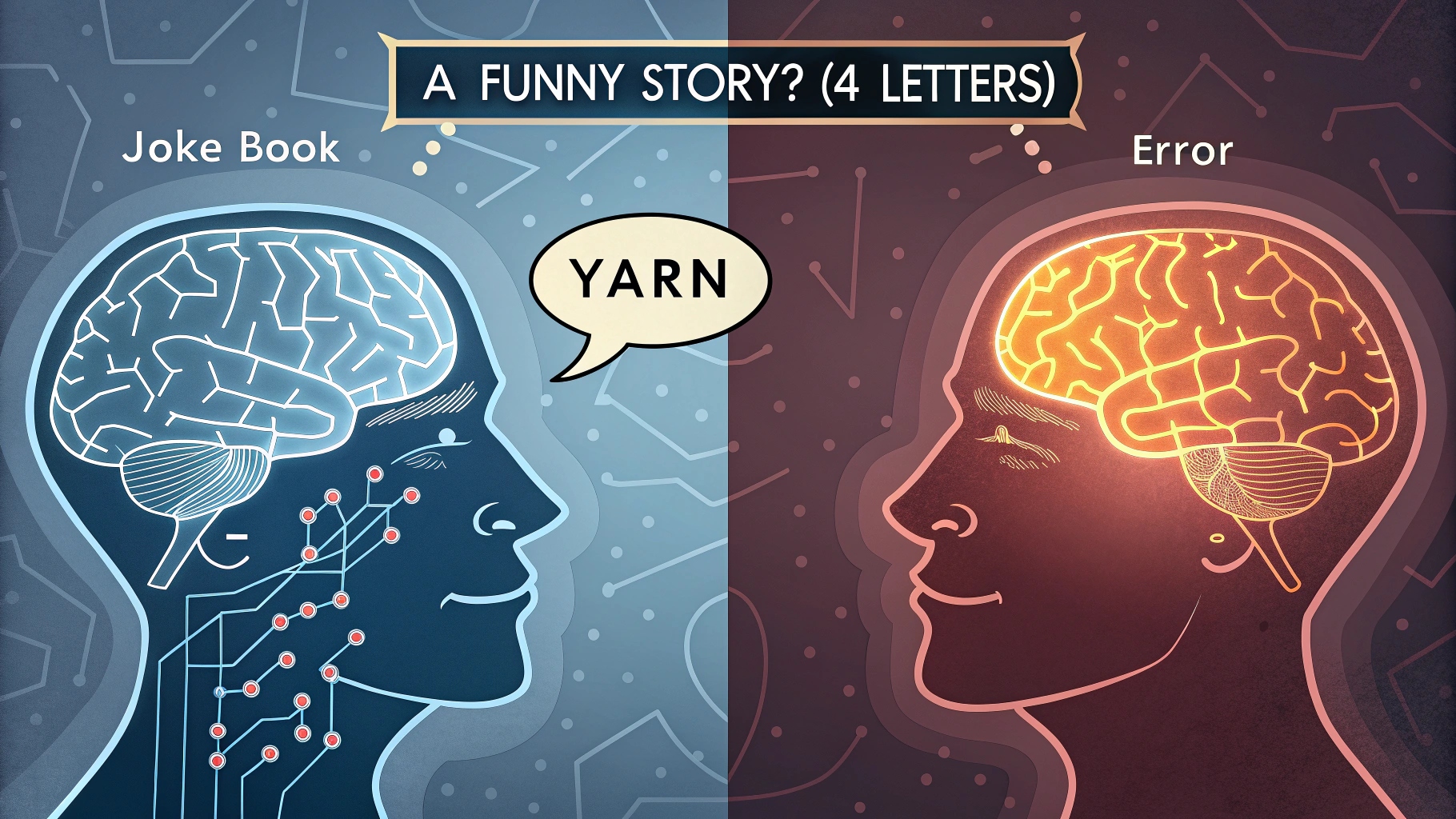
A clue like “A funny story? (4 letters)” requires a human to make a creative leap. You understand the beautiful play on words between a “story” (a narrative) and a “story” (a floor of a building). You also get the double meaning of “funny” (humorous vs. strange). An AI, seeing this, will likely search its database for four letter synonyms of “joke” or “tale.” It struggles to understand the delightful pun that leads to the answer “YARN.” It simply lacks a sense of humor.
It Can’t See the Big Picture: The Blindness to Themes
A clever theme is the soul of a great puzzle. The answers might all be related in a subtle, witty way that only becomes clear as you solve. A human solver experiences a growing sense of discovery as the theme reveals itself. An AI solves clue by clue, in isolation. It cannot appreciate the overarching theme. It can’t have that incredible “Aha!” moment where it realizes all the long answers are titles of Beatles songs, but with one word cleverly replaced by a type of fish. The AI can fill in the grid, but it misses the point entirely. It solves the puzzle, but it doesn’t get the puzzle. To truly appreciate the theme, you need human crossword solving strategies.
It’s Always a Step Behind: The Pop Culture Gap
While an AI’s database is vast, it can be slow to update and lacks true understanding. A clue referencing a recent, viral internet meme, a line from a hit TV show that aired last night, or a subtle political joke will often stump an AI. It lacks the real time, lived in cultural context that humans possess. By the time a meme is well documented enough for an AI to learn it, it’s often no longer relevant enough to be in a cutting edge crossword.
It Misses the Magic: The “Aha!” Moment
This is perhaps the most profound difference. The goal of solving a crossword isn’t just to have a completed grid. It’s about the experience of the solve itself.
There is a unique and deeply satisfying cognitive reward that comes from struggling with a clue and finally breaking it. It’s a jolt of dopamine, a feeling of accomplishment that makes your brain feel alive. An AI does not experience this. It feels no joy. It simply executes a command. Using an AI to get an answer robs the human solver of this fundamental reward.
Similarly, experienced human solvers develop a powerful intuition. They get a “feel” for a puzzle maker’s style. They can make an educated guess based on a hunch that “feels right.” This is a complex form of subconscious pattern matching that AI cannot replicate. An AI’s guesses are based purely on statistics, not on a holistic feel for the puzzle’s personality.
So, Should You Use an AI Solver? A Solver’s Honest Advice
Is there a place for AI in a crossword solver’s toolkit? The answer is complex. Like any powerful tool, its value depends entirely on how it’s used. It can be a helpful learning aid or a detrimental crutch.
Using AI as a Smart Tool
Used strategically and sparingly, an AI solver can be a valuable learning aid.
- Checking Answers: After you’ve finished a puzzle to the best of your ability, you can use an AI to check your work and see where you went wrong. This is a great way to learn from your mistakes.
- Understanding Obscure Clues: If you’re truly stuck on a clue involving a word you’ve never heard of, using a solver to get the answer can be a way to expand your vocabulary for next time. The key is to then research that word and understand its meaning, rather than just filling it in and moving on.
- Breaking Through a Wall: If one single, impossible clue is preventing you from solving an entire section, getting that one answer can sometimes be the key to unlocking the rest of the puzzle, allowing you to continue the enjoyable process of solving the parts you can figure out on your own.
Below is a table of some common AI tools and how they are typically used, which can help you understand the landscape if you choose to explore them for learning purposes.
| Tool Name | Key Features | Ideal For |
| Crossword Genius AI | Pattern recognition, data driven suggestions | Beginners to advanced solvers looking to check work. |
| PuzzleSolver Pro | Real time clue analysis, interactive interface | NYT and cryptic crossword enthusiasts analyzing tough clues. |
| AI Puzzle Assistant | Adaptive learning, error correction | Rapid solving practice and educational use. |
The Danger of the Crutch
The danger lies in becoming reliant on the AI. If you turn to a solver at the first sign of difficulty, you are not exercising your mental muscles. You are short circuiting the learning process and robbing yourself of the cognitive benefits and the satisfaction of the solve. It becomes a hollow victory, like looking up the answer to a riddle. You get the answer, but you miss the fun. The temptation for an instant solution can ultimately weaken the very skills that make crossword solving so rewarding.
The Human Brain is Still the Best Solving Tool
While AI solvers are a fascinating technological feat, they fundamentally miss the point of a crossword puzzle. They can process the language, but they cannot appreciate the artistry. They can match patterns, but they cannot understand humor, culture, or wit. They can give you an answer, but they can’t give you the rewarding, enriching, and ultimately human experience of the solve.
At DazePuzzle, we will continue to champion that human journey. We believe the true prize isn’t a finished grid; it’s a sharper mind, a richer vocabulary, and the pure, unadulterated joy of cracking the code yourself. The human brain, with all its beautiful complexities and creative sparks, is, and will remain, the most powerful crossword solving tool there is.