From coast to coast, America’s puzzle taste is anything but uniform. We compared search interest across all 50 states to find out where people seem to be most obsessed with popular puzzle games.
In a break room somewhere in the Midwest, a lunch break is quietly being sacrificed to a puzzle emergency. Multiply that by 50 states, and you’ve got a nation collectively refusing to put its phone down.
Daze Puzzle combined Google Trends and Keyword Planner data for five popular puzzle games to see where search interest is strongest relative to the rest of the country.
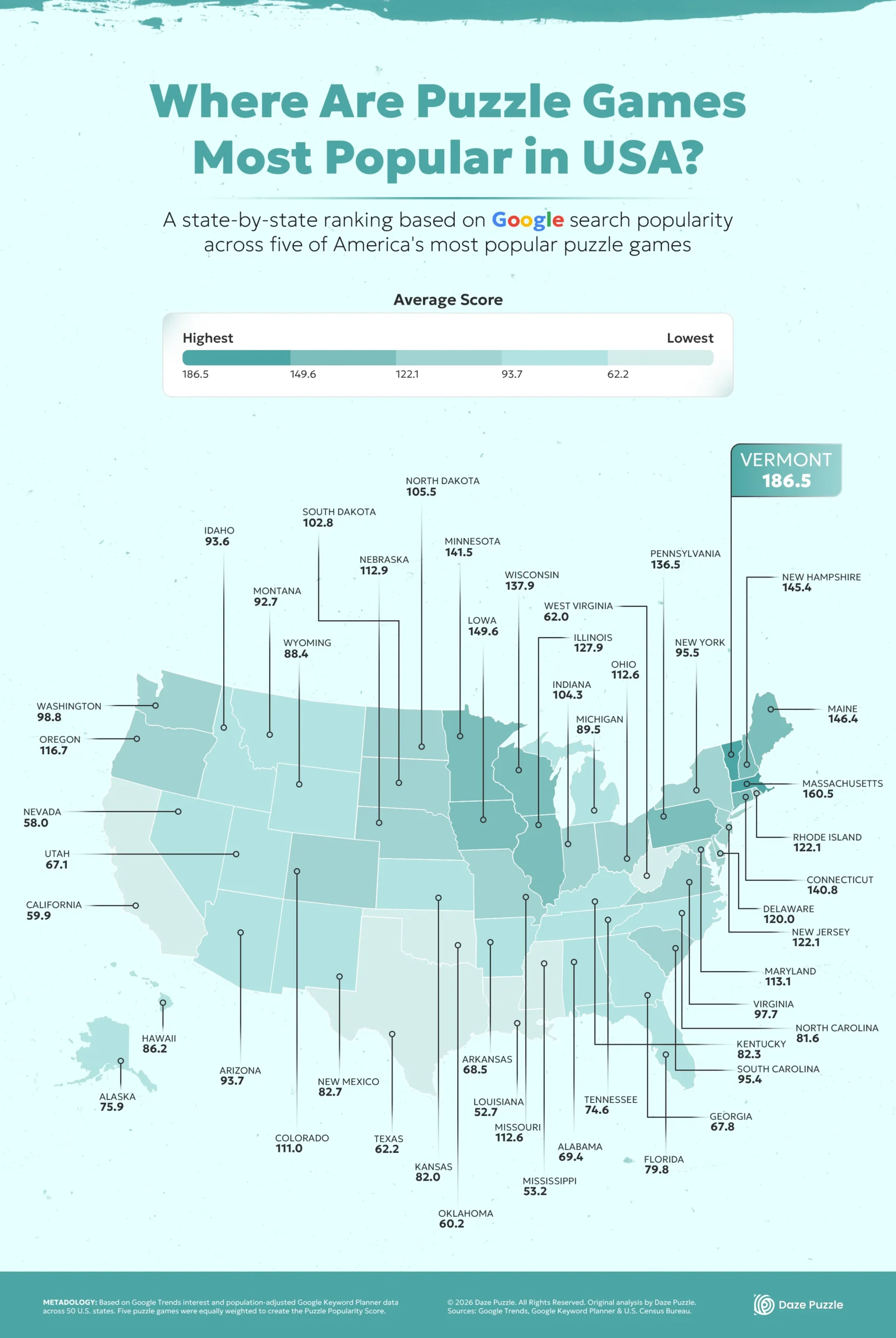
Vermont came out on top with a Puzzle Interest Index of 186.5, followed by Massachusetts and Iowa. New England seems to have caught a serious case of puzzle fever. At the other end, Louisiana finished last, while California and Texas landed surprisingly close to the bottom.
America clearly has a thing for puzzles. It just depends on which state you’re standing in!
Key Findings
- Vermont ranks first overall at 186.5, ahead of Massachusetts and Iowa. Its 60% fiction-reading estimate in 2022 offers one possible explanation for its strength in word games.
- All six New England states finish in the top 12. Strong reading figures and older populations in Maine and Vermont may help explain the region’s showing.
- Iowa is the only state to win two categories, NYT Strands and Crossword. Above-average public-library use offers a possible cultural connection.
- Six Midwestern states make Wordle’s top 10, with Minnesota in first place.
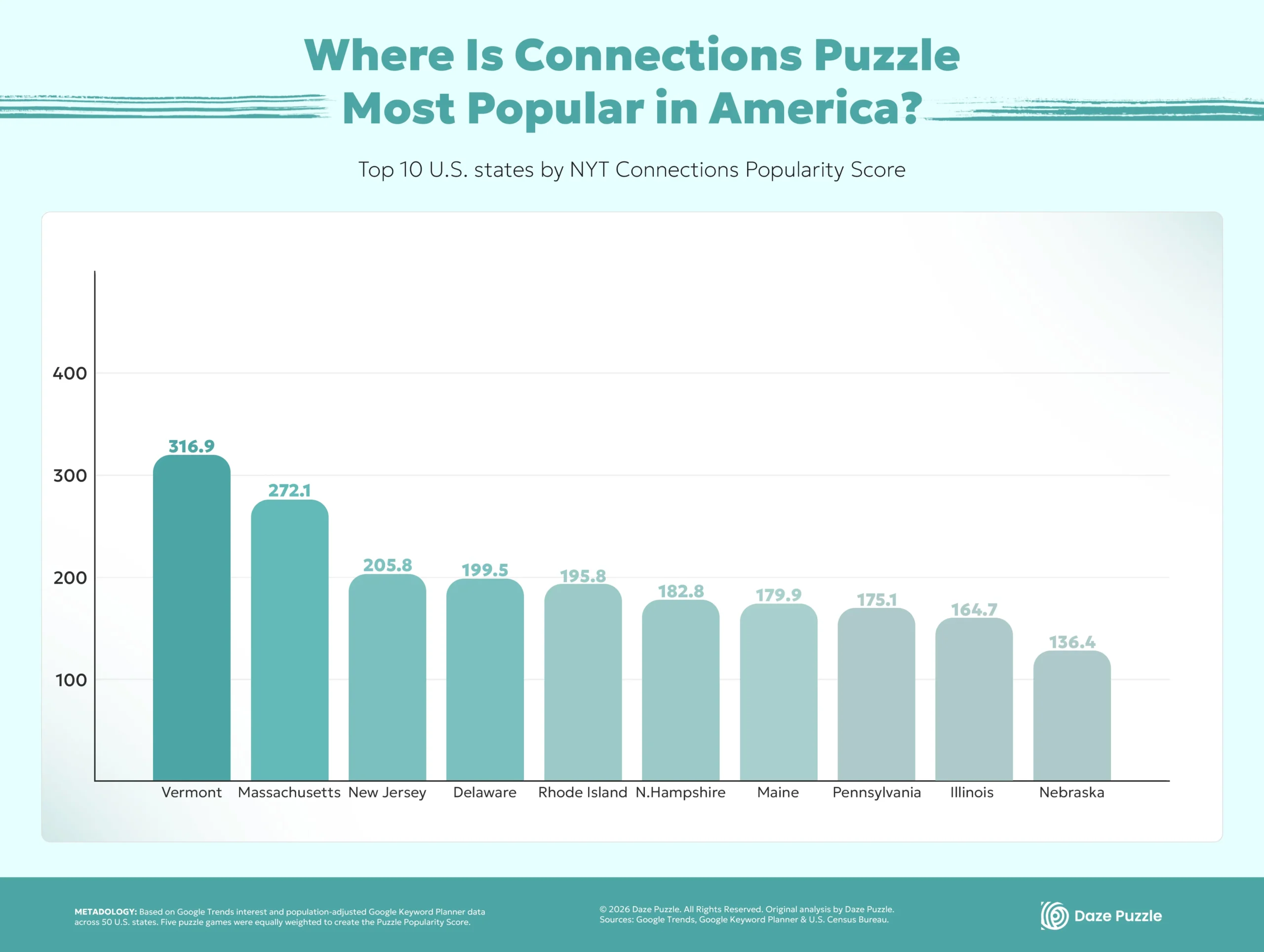
- Vermont’s NYT Connections score of 316.9 is the highest individual score across all five puzzle rankings.
Vermont Is America’s Biggest Puzzle-Loving State
We should probably take a trip to Vermont and see what is going on over there!
With a Puzzle Interest Index of 186.5, Vermont leads the country, putting it 86.5% above our national baseline of 100. Massachusetts follows at 160.5, while Iowa takes third at 149.6.
Two of the top three are in New England, and that is only the beginning.
Vermont’s reading habits make that result a little less surprising. The National Endowment for the Arts’ 2022 survey estimated that 60% of adults had read novels or short stories in the previous year, compared with 38% nationally. With word games filling four of our five categories, we suspect some of that enthusiasm for reading carries over to the puzzle page.
New England Region Reigns in Puzzle Games Interest
Vermont and Massachusetts are not alone. Maine ranks fourth, New Hampshire fifth, Connecticut seventh, and Rhode Island 12th.
That means every New England state appears within the top 12. It is pretty hard to ignore a pattern like that. Maybe we should just rename New England to Fan of Puzzles!
Age may help too. Residents aged 65 and over account for 24.6% of Maine and 24.1% of Vermont, versus 18.9% nationally. ESA/YouGov’s 2026 national research identifies older players as a key audience for puzzle games. It also found that 60% of Boomer and Silent Generation gamers played video games to use their brains or keep their minds sharp.
We think that preference could be part of the appeal here.
Iowa Leads the Country in NYT Strands Interest
NYT Strands looks especially popular in Iowa.
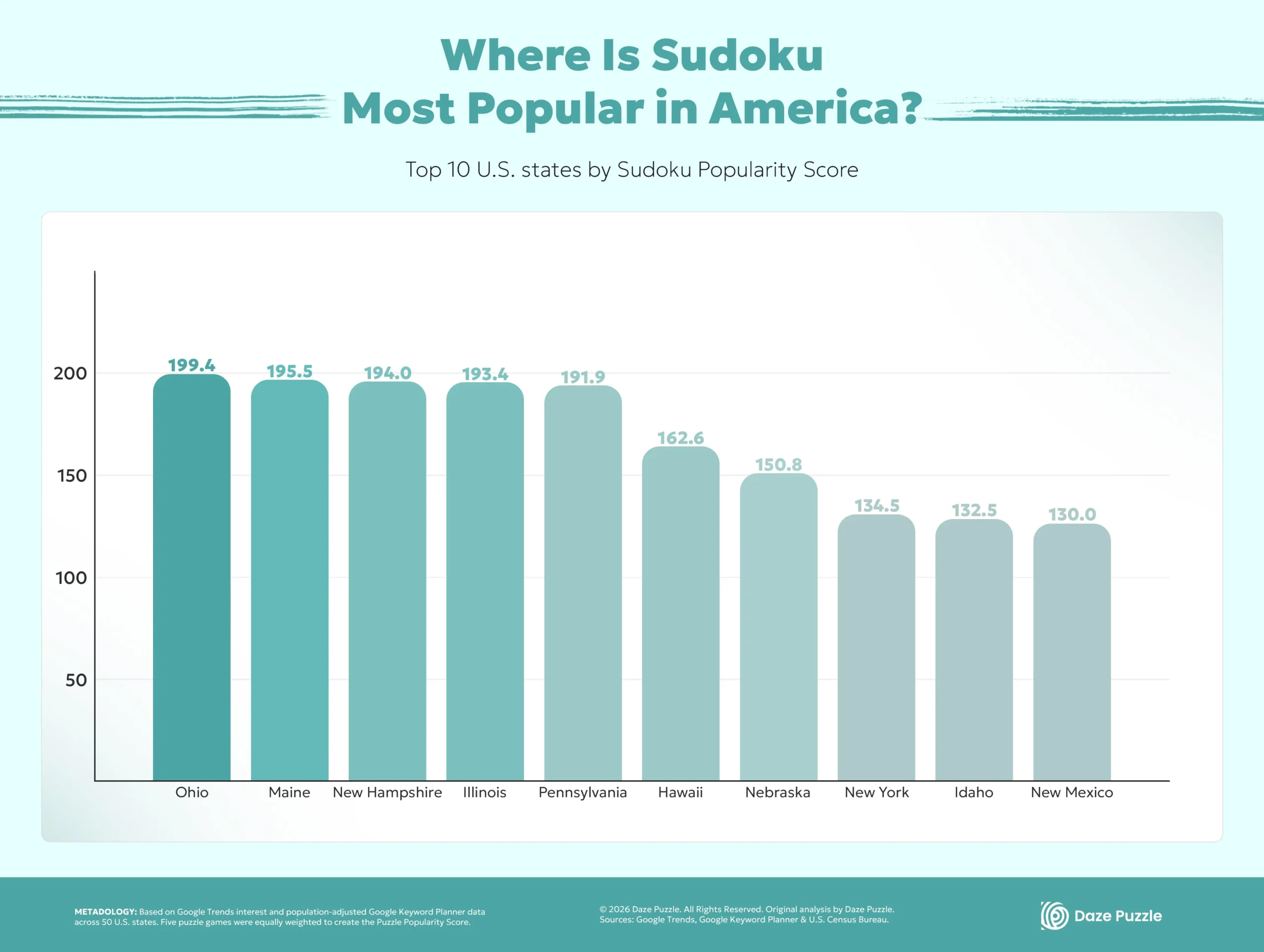
Iowa ranks first with a Strands Popularity Score of 224.1, followed by Connecticut at 215.1 and Vermont at 186.5. Oregon ranks fourth at 170.4, Minnesota fifth at 169.6, and Wisconsin sixth at 166.5.
The Midwest also makes a strong showing, with Iowa, Minnesota, Wisconsin, and Missouri all inside the top 10.
Iowa’s libraries offer another angle on its word-game habit. The State Library of Iowa’s FY2023 comparison recorded 3.78 library visits per resident, versus 2.47 nationally. We think that level of library use makes reading culture worth considering here.
Still, visits are not a reading tally. The NEA’s 2022 estimate for fiction reading in Iowa was 36%, close to the national 38%.
Ohio Takes the Top Spot for Sudoku
Sudoku gives us a completely different leaderboard.
That change makes sense to us. Sudoku relies on number placement rather than English vocabulary, and publisher Nikoli points out that it needs no arithmetic. A game without that vocabulary requirement could attract a different audience, even if that does not tell us why Ohio edges ahead.
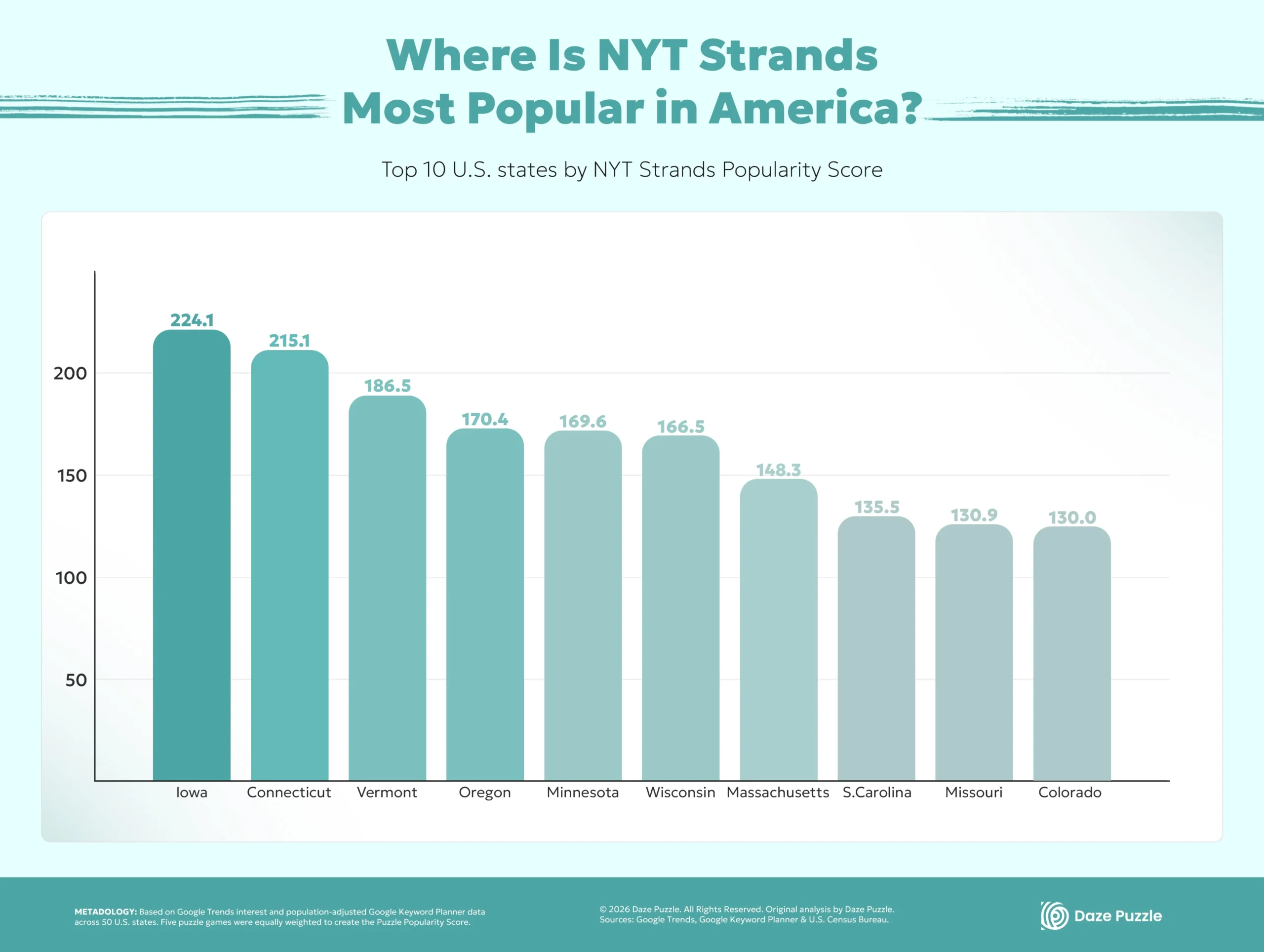
Ohio ranks first at 199.4, followed closely by Maine at 195.5, New Hampshire at 194.0, Illinois at 193.4, and Pennsylvania at 191.9. Only 7.5 points separate first from fifth.
Hawaii ranks sixth with 162.6, while Nebraska, New York, Idaho, and New Mexico complete the top 10.
Unlike some of the other puzzles, nobody really runs away with Sudoku.
Vermont Is in a League of Its Own for NYT Connections
Maybe those purple categories are easier when you live in New England. If one chart explains Vermont’s overall position, it is NYT Connections.
Vermont scores 316.9, the highest individual score across any of the five puzzle-game rankings. Massachusetts follows at 272.1, with New Jersey third at 205.8.
Vermont, Massachusetts, Rhode Island, New Hampshire, and Maine all appear in the Connections top 10.
Pew’s October 2025 survey found that 88% of college graduates had read at least part of a book in the previous year, compared with 60% of adults with a high school education or less. We suspect that connection with reading helps word puzzles find an audience in both states.
Minnesota and Wisconsin Love Wordle
Wordle shifts the attention back toward the Midwest.
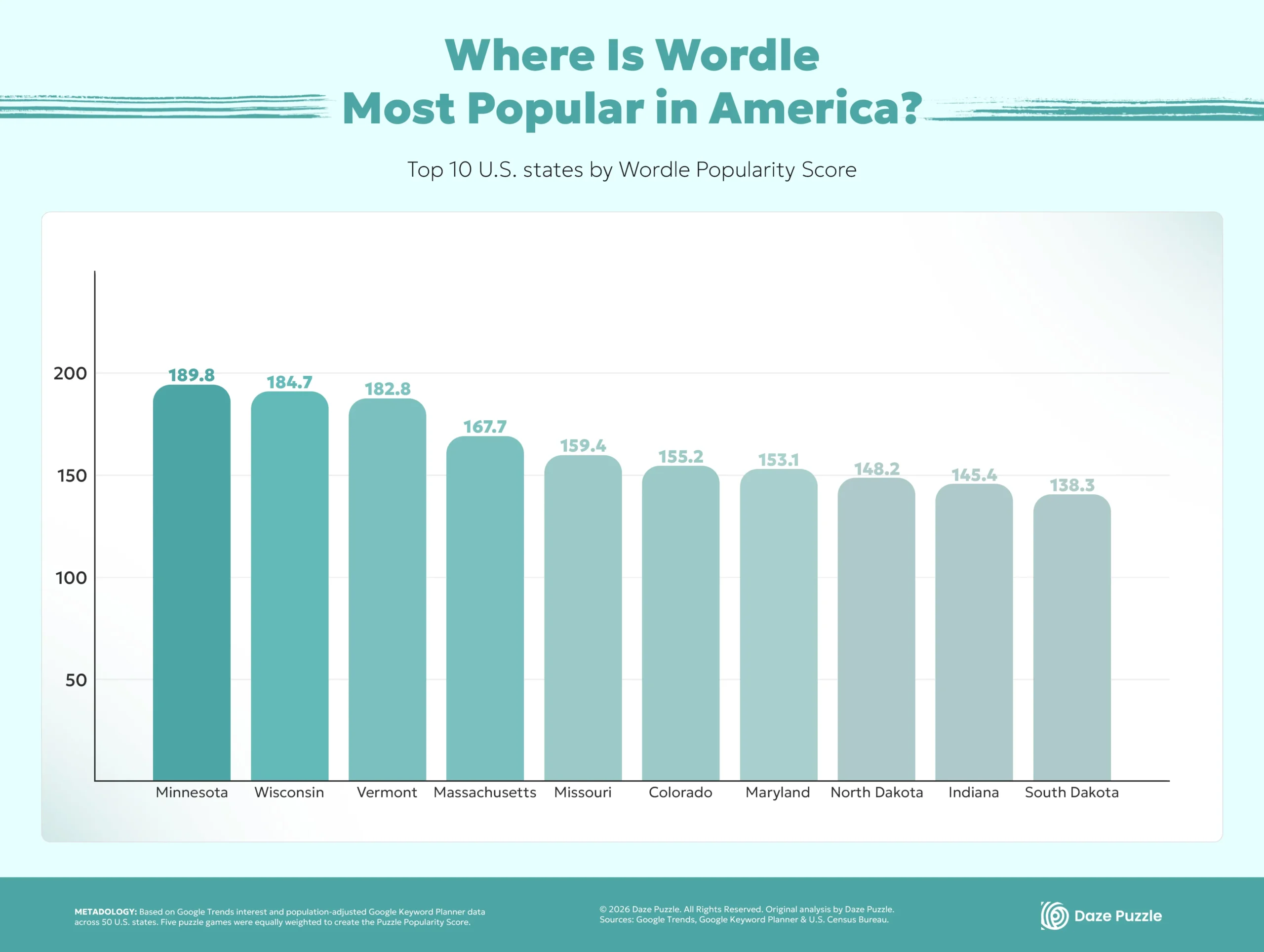
Minnesota ranks first at 189.8, followed by Wisconsin at 184.7. Vermont takes third at 182.8, while Massachusetts comes fourth at 167.7.
Missouri places fifth, North Dakota eighth, Indiana ninth, and South Dakota tenth. Six of Wordle’s top 10 states are in the Midwest.
New England may dominate overall, but Wordle seems to have found another home.
Iowa Also Comes Out on Top for Crossword
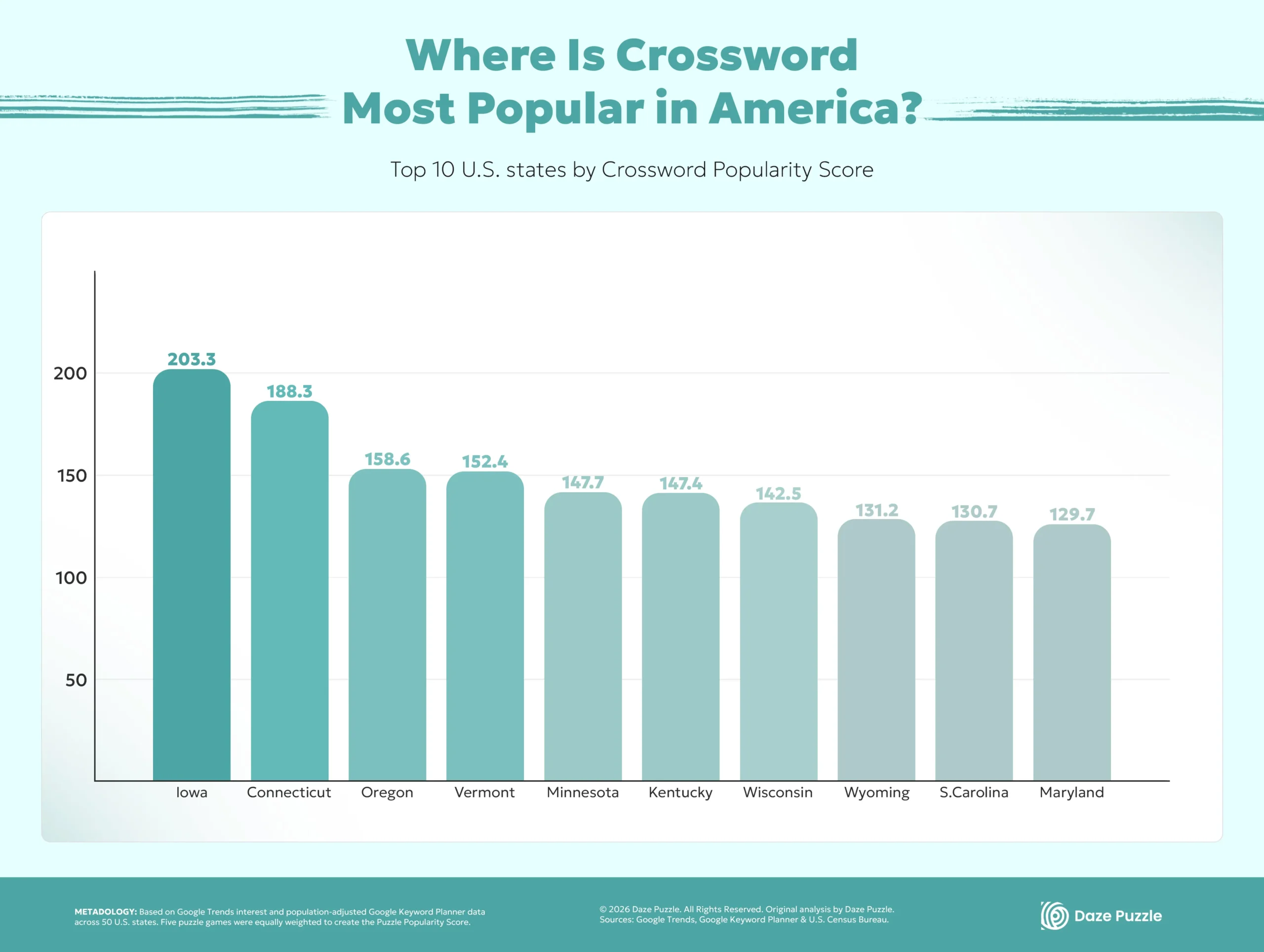
Iowa doesn’t just lead NYT Strands. It also has the country’s highest Crossword Popularity Score at 203.3.
Connecticut follows at 188.3, Oregon at 158.6, Vermont at 152.4, and Minnesota at 147.7. Kentucky, Wisconsin, Wyoming, South Carolina, and Maryland complete the top 10.
Compared with Connections or Wordle, Crossword interest is less concentrated in one region.
But Iowa has made its position pretty clear: give them a grid, and they are interested.
California and Texas Rank Surprisingly Low
Some of the biggest states are nowhere near the top of the puzzle rankings.
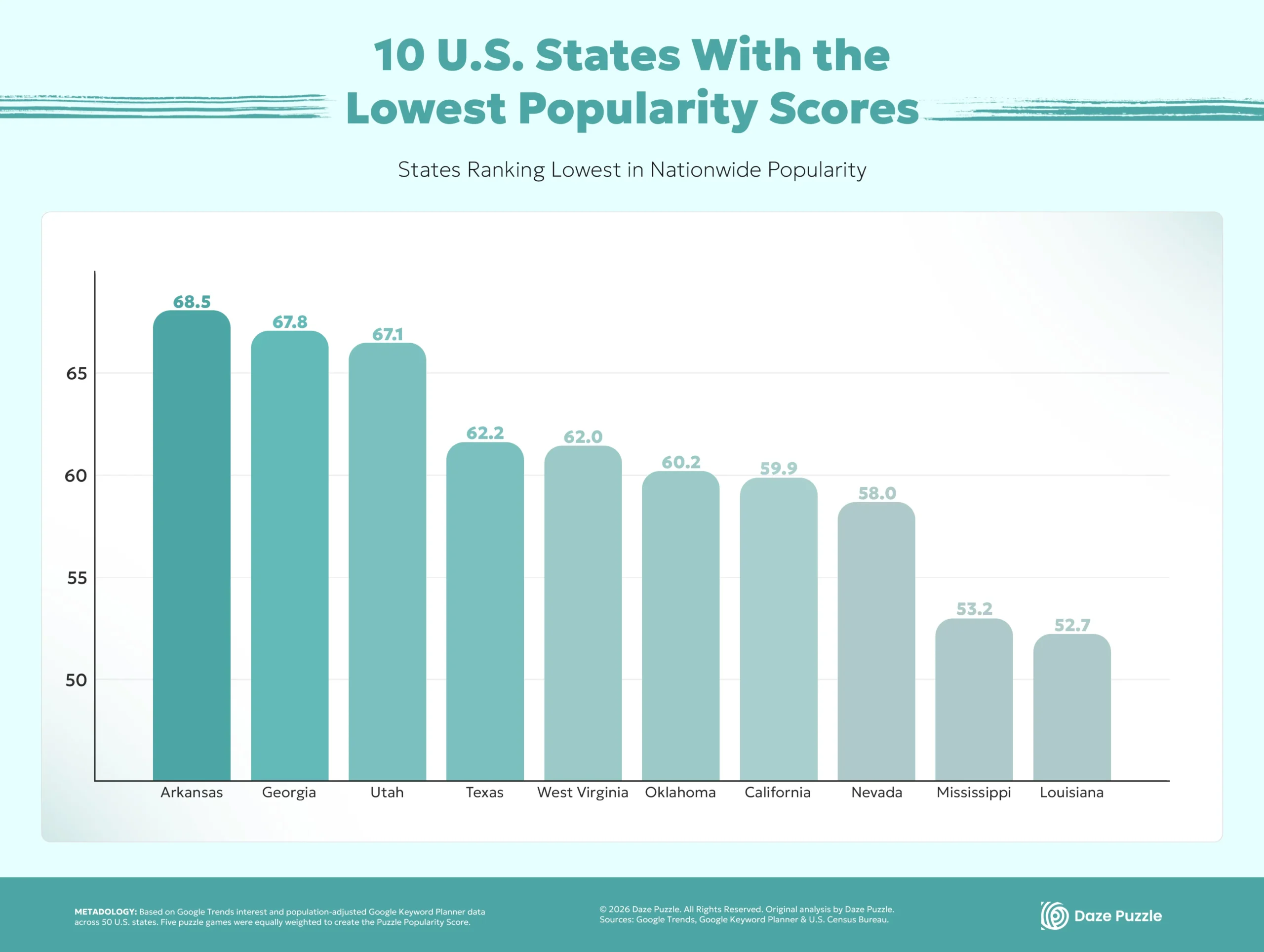
Louisiana finishes last overall, while California and Texas also land surprisingly close to the bottom. That is a pretty big contrast with smaller states such as Vermont, Maine, and New Hampshire, which repeatedly appear near the top.
Of course, that does not mean Californians or Texans solve fewer puzzles in total. Our rankings measure relative search interest and adjust Keyword Planner data for population, so being a bigger state does not automatically give you an advantage.
Different Puzzles Create Very Different State Rankings
There isn’t a single type of “puzzle state.”
Iowa leads both NYT Strands and Crossword. Ohio takes Sudoku. Minnesota tops Wordle. Vermont dominates NYT Connections.
Four of our five games are built around words, which is why reading keeps coming up in our analysis. A 1999 study in the Journal of Experimental Psychology: General found that general knowledge was the strongest predictor of crossword-solving skill.
That research measured ability rather than search interest. Still, it gives us a reason to consider reading and accumulated knowledge when interpreting a ranking so heavily weighted toward word games.
Vermont is especially consistent, appearing in the top four for Strands, Connections, Wordle, and Crossword, which helps explain why it finishes first overall.
The results also show why population alone tells us very little. Small states such as Vermont, Maine, and New Hampshire repeatedly appear near the top.
So where do America’s biggest puzzle fans live?
The answer apparently depends on which puzzle you put in front of them.
Methodology
To identify which U.S. states show the strongest interest in popular puzzle games, we analyzed Google Trends and Keyword Planner data for Crossword, Sudoku, Wordle, NYT Connections, and NYT Strands across all 50 states.
For Google Trends, each game used the same location, time period, category, and search type:
- Location: United States
- Time period: Aug 1, 2025 to Aug 31, 2026
- Category: All
- Search Type: Web search
Because Google Trends reports relative interest on a 0–100 scale rather than absolute search volume, we converted each state’s score into an index against the 50-state average:
Game Interest Index = (State Score ÷ 50-State Average) × 100
An index of 100 represents the 50-state average. A score of 120 means relative search interest is 20% higher than average. All five games were weighted equally, meaning each game contributed 20% to a state’s Google Trends score.
We added the five Game Interest Index scores for each state and divided the total by five to calculate that state’s average Google Trends score.
For Keyword Planner, we collected average monthly search volumes for the same five games and adjusted them using each state’s 2025 population estimate from the U.S. Census Bureau.
We first calculated searches per 100,000 residents:
Searches per 100,000 = (Average Monthly Searches ÷ State Population) × 100,000
Then we compared each state’s population-adjusted rate with the 50-state average:
Keyword Planner Index = (State Searches per 100,000 ÷ 50-State Average Searches per 100,000) × 100
Finally, we combined each state’s Google Trends and Keyword Planner scores and divided the result by two to create the final Puzzle Interest Index.
Washington, D.C. was excluded, so the analysis covers the 50 U.S. states only.
The ranking measures relative search popularity, not exact player numbers. Google Trends measures relative interest, while Keyword Planner historical volumes are rounded estimates, so the results do not represent downloads, player counts, or actual playtime.
The demographic and cultural comparisons provide context only and did not affect the scores. Census education figures cover 2020-2024; age figures use 2025 estimates. NEA reading data comes from its 2022 survey, and Iowa library comparisons use FY2023 data. Pew’s reading survey was conducted in October 2025, while ESA/YouGov’s gaming survey was conducted in 2026.
These sources measure different populations and activities. We have not statistically tested these explanations across all 50 states, so they should be read as possibilities, not proven causes.